


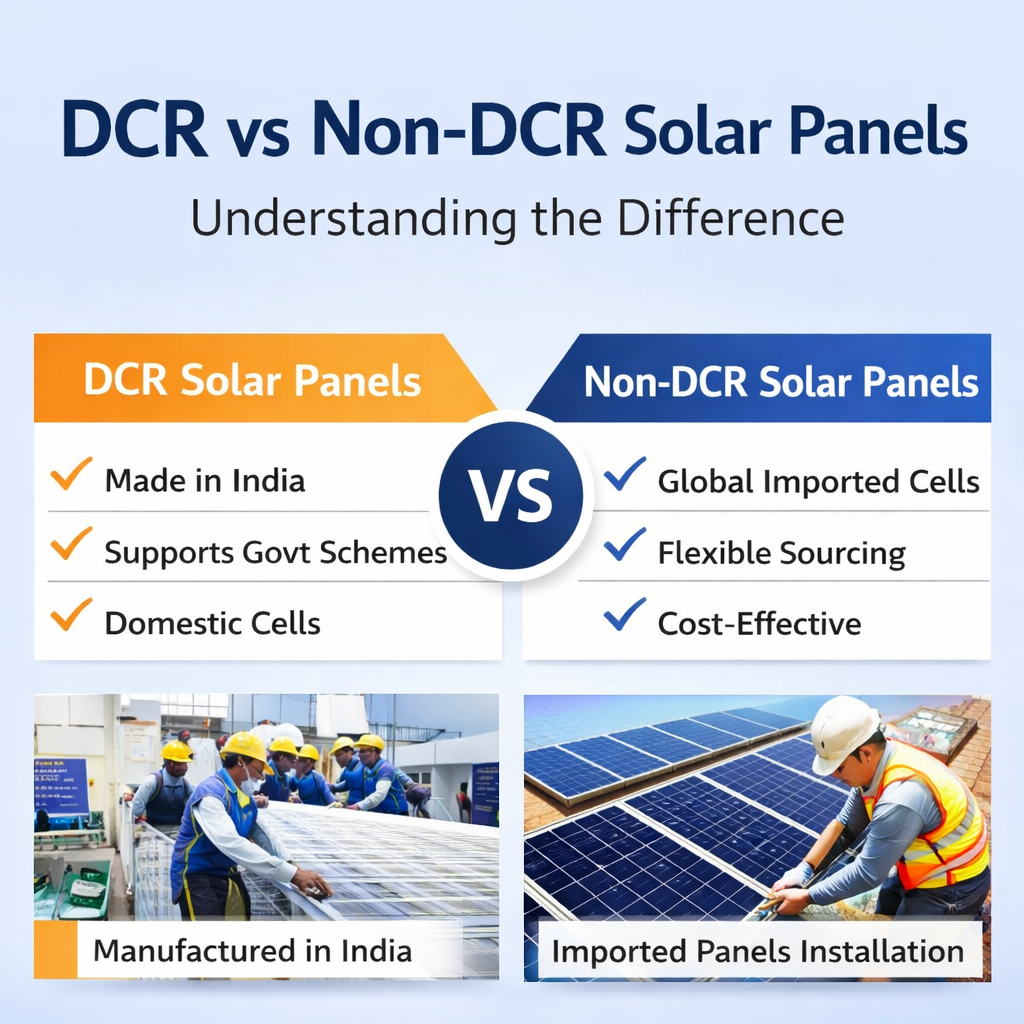

If you are planning a solar installation, you may have come across the terms DCR vs Non-DCR solar panels. While both types generate electricity from sunlight, they differ mainly in manufacturing origin and government policy compliance.
Understanding the difference between DCR and Non-DCR solar panels is important before making an investment decision.
What Is a DCR Solar Panel?
DCR stands for Domestic Content Requirement.
A DCR solar panel uses solar cells and modules manufactured within India. These panels comply with government policies that promote domestic manufacturing under certain renewable energy schemes.
DCR panels are usually mandatory in:
-
Government-backed solar projects
-
Subsidy-linked installations
-
CPSU and MNRE-supported schemes
The primary purpose of DCR solar panels is to strengthen India’s local solar manufacturing industry.
What Is a Non-DCR Solar Panel?
A Non-DCR solar panel does not follow domestic manufacturing restrictions. The solar cells may be imported from global manufacturers and assembled locally or internationally.
Non-DCR solar panels are widely used in:
-
Residential rooftop solar systems
-
Commercial and industrial projects
-
Private installations not linked to DCR policies
Because of flexible sourcing, Non-DCR panels often offer competitive pricing and wider availability.
DCR vs Non-DCR Solar Panels: Key Differences
When comparing DCR vs Non-DCR solar panels, the difference is mainly regulatory rather than performance-based.
1. Manufacturing Origin
-
DCR panels: Manufactured domestically in India
-
Non-DCR panels: Cells may be imported from international suppliers
2. Policy Compliance
DCR solar panels comply with government Domestic Content Requirement policies. Certain subsidy programs require DCR modules to qualify for benefits.
Non-DCR panels are free from such restrictions and can be used in open-market projects.
3. Project Eligibility
Under MNRE guidelines, specific projects must use DCR panels to receive incentives or financial support. Non-DCR panels are suitable for projects that do not fall under these mandatory schemes.
Choosing the correct category ensures compliance and avoids loss of eligibility for government benefits.
Is There a Performance Difference?
Many people assume DCR vs Non-DCR solar panels differ in efficiency. In reality, performance depends more on:
-
Cell technology (Mono PERC, TOPCon, etc.)
-
Manufacturing quality
-
Temperature coefficient
-
Installation standards
Both DCR and Non-DCR panels can offer similar efficiency levels depending on the brand and technology used.
The difference lies mainly in manufacturing source and regulatory classification.
Advanced Technologies Available in Both Categories
Modern solar panels include advanced technologies such as:
-
Bifacial modules – Capture sunlight from both sides
-
Dual glass modules – Enhanced durability
-
TOPCon technology – Higher efficiency
These innovations can be found in both DCR and Non-DCR solar panels, depending on the manufacturer.
How to Choose Between DCR and Non-DCR Solar Panels
When deciding between DCR vs Non-DCR solar panels, consider the following:
Check Subsidy Requirements
If your project requires government subsidy compliance, DCR panels may be mandatory.
Evaluate Budget
Non-DCR panels may offer competitive pricing in open-market projects.
Confirm Project Type
Government-linked projects may require DCR modules, while private residential systems can use either option.
Consulting a qualified solar provider helps ensure proper compliance and optimal system selection.
Final Thoughts on DCR vs Non-DCR Solar Panels
The difference between DCR vs Non-DCR solar panels is primarily about policy compliance and manufacturing origin—not necessarily performance.
Before investing in a solar system, evaluate:
-
Government scheme eligibility
-
Budget constraints
-
Long-term energy goals
-
Technical specifications
A clear understanding of DCR vs Non-DCR solar panels ensures a compliant, cost-effective, and sustainable solar installation.
Frequently Asked Questions (FAQ)
1. What is the main difference between DCR and Non-DCR solar panels?
The main difference between DCR and Non-DCR solar panels lies in their manufacturing origin and policy compliance. DCR panels use domestically manufactured solar cells as per government Domestic Content Requirement policies, while Non-DCR panels may use imported cells and are not bound by such restrictions.
2. Are DCR solar panels more efficient than Non-DCR panels?
No, efficiency does not directly depend on whether a panel is DCR or Non-DCR. Performance mainly depends on the technology used (such as TOPCon or Mono PERC), manufacturing quality, and installation standards rather than regulatory classification.
3. When is it mandatory to use DCR solar panels?
DCR solar panels are mandatory in certain government-backed or subsidy-linked projects where Domestic Content Requirement compliance is specified under MNRE guidelines. Private rooftop installations without subsidy conditions can typically use either option.
4. Can residential homeowners choose Non-DCR solar panels?
Yes. Most residential rooftop solar systems that are not tied to specific government schemes can use Non-DCR solar panels. They are widely available and commonly used in open-market installations.
5. Which is better for long-term investment: DCR or Non-DCR?
Both DCR and Non-DCR solar panels can be reliable long-term investments if sourced from reputable manufacturers. The right choice depends on subsidy eligibility, budget, project requirements, and compliance considerations rather than performance differences alone.