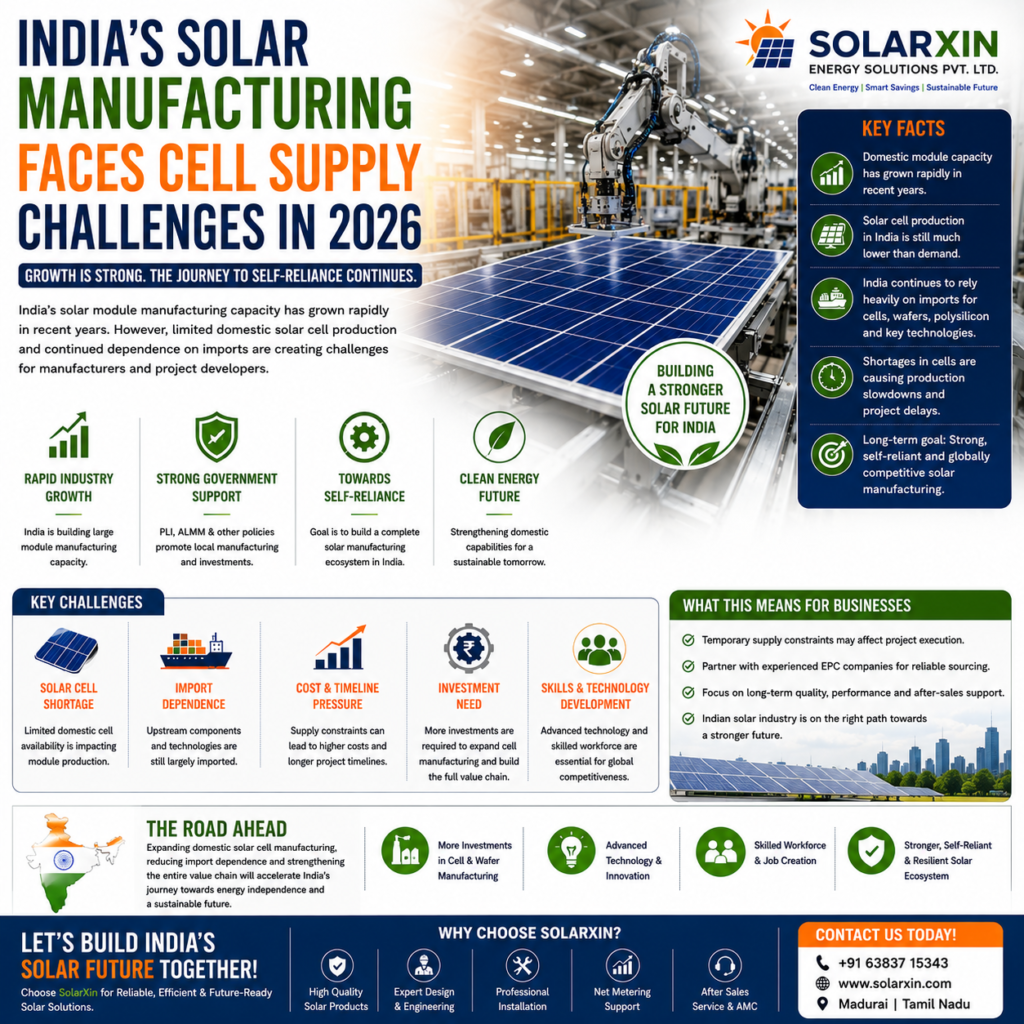




India Solar Manufacturing has grown at an impressive pace over the last few years, positioning the country as one of the world’s fastest-growing renewable energy markets. Government initiatives, production-linked incentives (PLI), ALMM regulations and rising domestic demand have encouraged companies to invest heavily in solar module manufacturing.
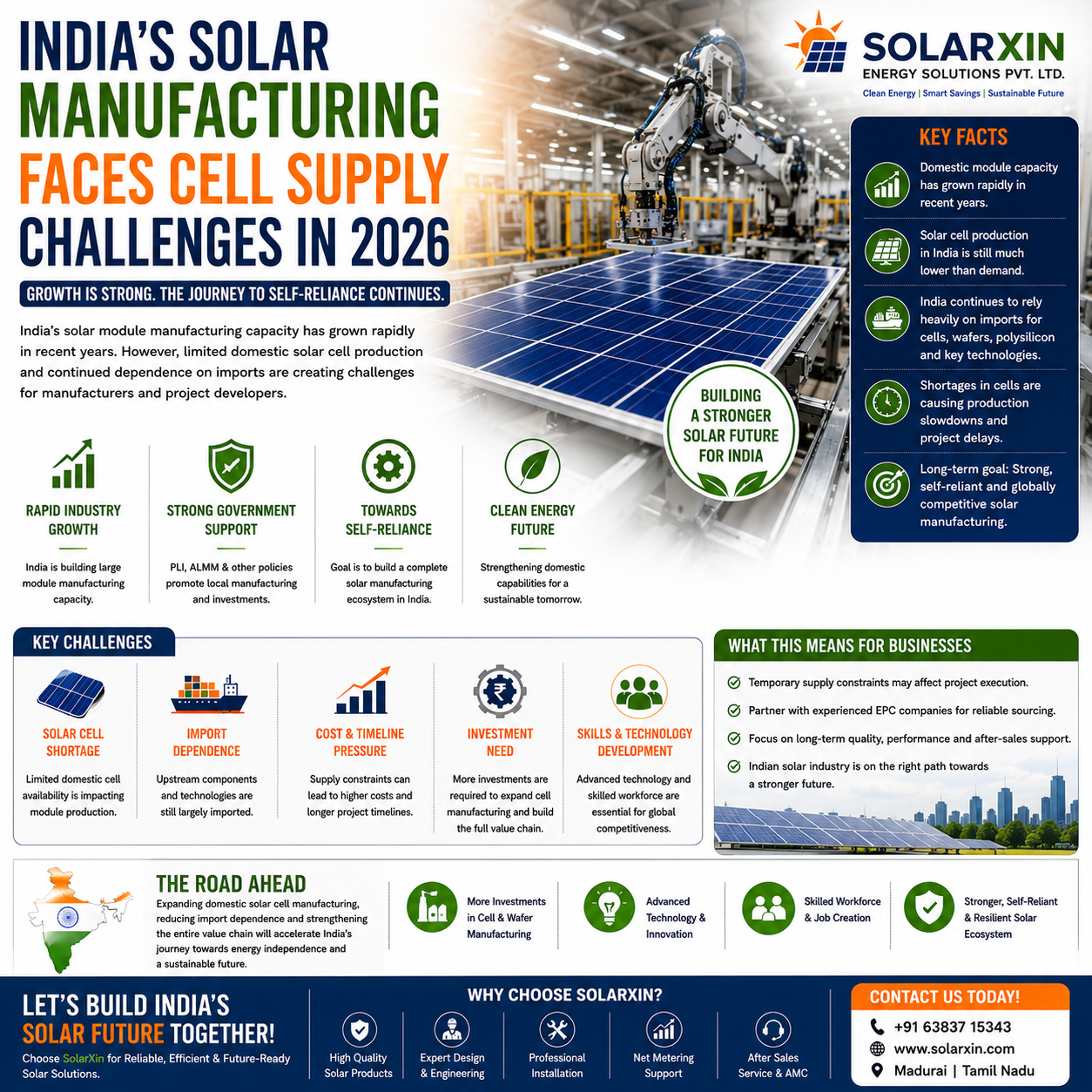
However, while module production capacity has expanded significantly, another challenge has emerged. The availability of domestically manufactured solar cells has not kept pace with demand, creating supply bottlenecks for manufacturers and developers across the country.
As India works towards achieving 500 GW of non-fossil fuel capacity by 2030, strengthening the entire solar manufacturing ecosystem—not just module assembly—has become increasingly important.

India’s Solar Industry Has Expanded Rapidly
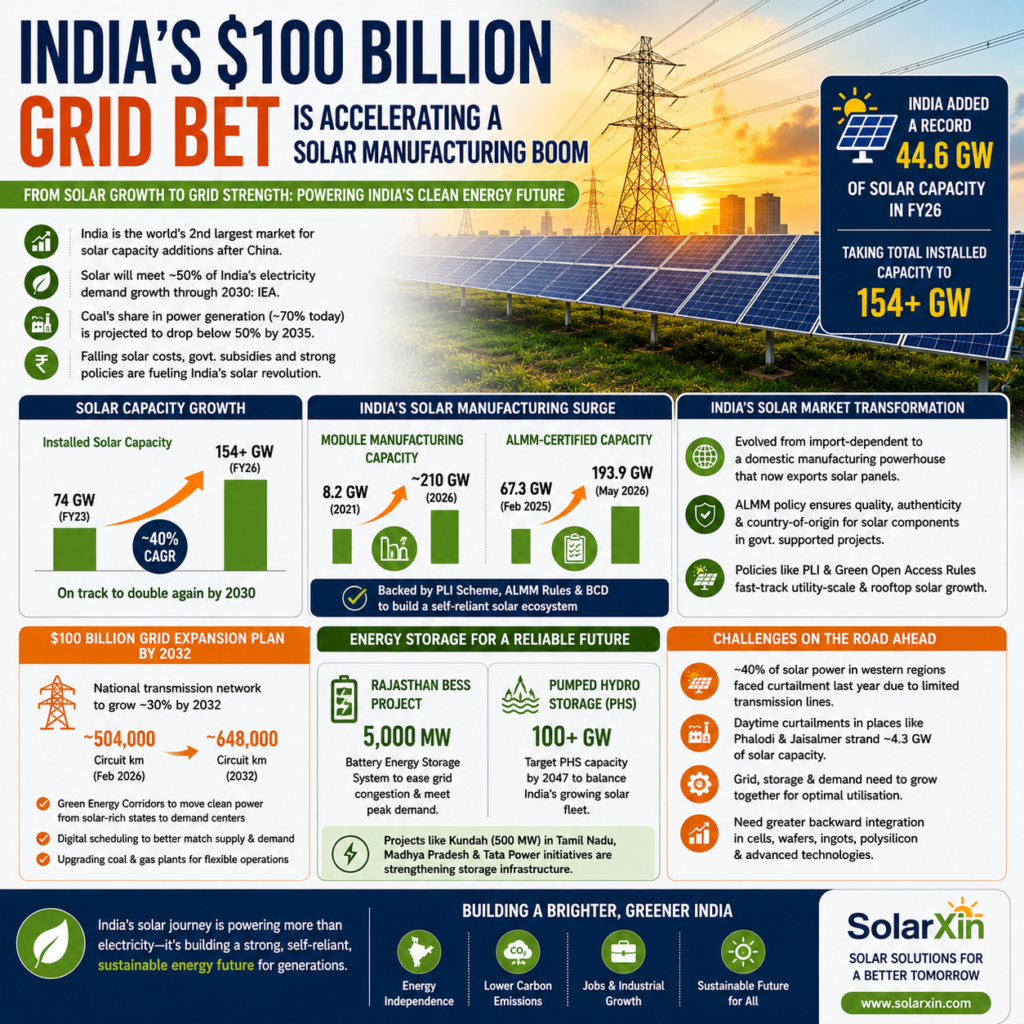
Over the past few years, India has transformed from a largely import-dependent solar market into one with substantial domestic manufacturing capability.
Large investments from both Indian and international companies have helped establish modern manufacturing facilities capable of producing high-quality solar modules. Government policies encouraging local production have further accelerated this growth.
The objective is clear: reduce dependence on imported components, improve energy security and build India into a global clean energy manufacturing hub.
Despite these achievements, the industry is still developing several upstream manufacturing segments.
Why Solar Cell Supply Has Become a Challenge
Solar modules are assembled using photovoltaic cells, making solar cells one of the most critical components in the manufacturing process.
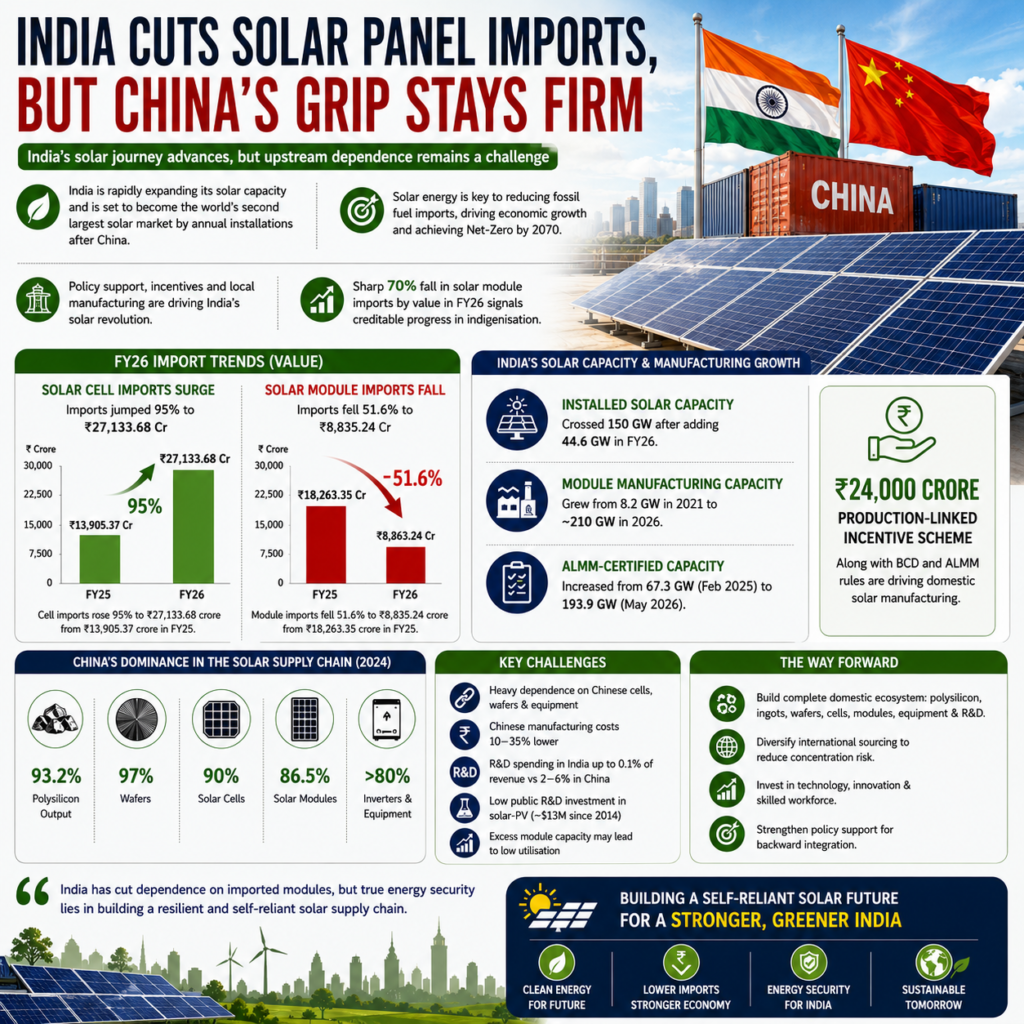
Although India’s module manufacturing capacity has expanded rapidly, domestic solar cell production remains considerably lower than market demand. This gap has resulted in longer delivery timelines for manufacturers that depend entirely on locally produced cells.
Industry reports indicate that several standalone module manufacturers have experienced production slowdowns because of limited cell availability after domestic sourcing requirements became stricter.
For businesses involved in solar manufacturing, balancing government localisation objectives with current production capacity remains one of the biggest challenges.
Dependence on China Still Exists
India has made significant progress in reducing imports of finished solar modules.
However, the industry continues to rely heavily on imports for solar cells, wafers, polysilicon, manufacturing equipment and specialised technology. China remains one of the largest suppliers across these upstream segments.
Building a complete manufacturing ecosystem requires substantial investment, advanced technology, skilled manpower and time.
Experts believe that developing competitive domestic production across the entire solar value chain will strengthen India’s long-term renewable energy ambitions while reducing supply chain risks.
Impact on Solar Projects
A shortage of solar cells can affect multiple areas of the renewable energy sector.
Manufacturers may experience delays in module production, while project developers could face longer procurement timelines and increased equipment costs. Higher component prices may also influence overall project economics until domestic manufacturing capacity expands further.
Despite these temporary challenges, industry experts remain optimistic that additional investments in cell manufacturing will gradually improve supply over the coming years.
Government Policies Continue to Support Local Manufacturing
India’s renewable energy strategy focuses on creating a complete domestic manufacturing ecosystem rather than relying solely on imported components.
Policies such as the Production Linked Incentive (PLI) scheme, Approved List of Models and Manufacturers (ALMM), customs duty measures and local manufacturing requirements are intended to encourage investments across the solar supply chain.
Several leading manufacturers are already expanding facilities to increase domestic production of solar cells and related components.
As these projects become operational, India is expected to reduce its dependence on imported inputs while improving manufacturing competitiveness.
Opportunities for the Solar Industry
Although current supply constraints present short-term challenges, they also create long-term opportunities.
Growing demand for domestic solar cells is expected to attract new investments in advanced manufacturing technologies, automation and research.
The expansion of upstream manufacturing can generate employment across engineering, production, logistics, quality control and renewable energy services.
India’s strong domestic demand also provides manufacturers with a stable market to support future expansion.
What This Means for Businesses and Customers
For commercial and industrial consumers planning rooftop or utility-scale solar projects, choosing an experienced EPC partner is becoming increasingly important.
Professional solar companies can optimise project planning, source quality components and minimise procurement delays through established supply networks.
Businesses should focus on long-term system quality rather than short-term equipment availability alone.
Selecting reliable solar panels, high-performance inverters and experienced installation teams will ensure better system performance throughout the project lifecycle.
Looking Ahead
India’s solar industry has already demonstrated remarkable growth, but the next stage of development depends on strengthening upstream manufacturing capabilities.
Expanding domestic production of solar cells, wafers and related technologies will improve supply chain resilience, support local employment and reduce dependence on imported components.
While current shortages may temporarily affect manufacturing and project execution, continued policy support and private investment are expected to strengthen the industry over the coming years.
As India moves closer to its renewable energy targets, a stronger and more integrated manufacturing ecosystem will play a vital role in ensuring long-term energy security and sustainable economic growth.
Why Choose SolarXin Energy Solutions?
SolarXin Energy Solutions provides end-to-end solar EPC services for residential, commercial and industrial customers. From system design and engineering to installation, commissioning and maintenance, our team delivers reliable solar solutions using high-quality components that maximise long-term performance and energy savings.
If you are planning a rooftop or commercial solar project, contact SolarXin today for a customised proposal tailored to your energy requirements.
Frequently Asked Questions
Why is India facing solar cell shortages?
Domestic solar cell production is growing but still lags behind demand, creating temporary supply constraints for module manufacturers.
Will solar projects become more expensive?
Some projects may experience short-term cost increases or procurement delays until additional domestic manufacturing capacity becomes operational.
Is India reducing dependence on China?
Yes. India has expanded module manufacturing significantly, but upstream components such as cells, wafers and polysilicon still rely heavily on imports while local production continues to grow.
How can businesses avoid project delays?
Working with experienced EPC companies like SolarXin helps ensure better planning, quality equipment sourcing and efficient project execution.