

Tamil Nadu Rooftop Solar Subsidy 2026: Up to ₹1 Lakh Additional Support Announced


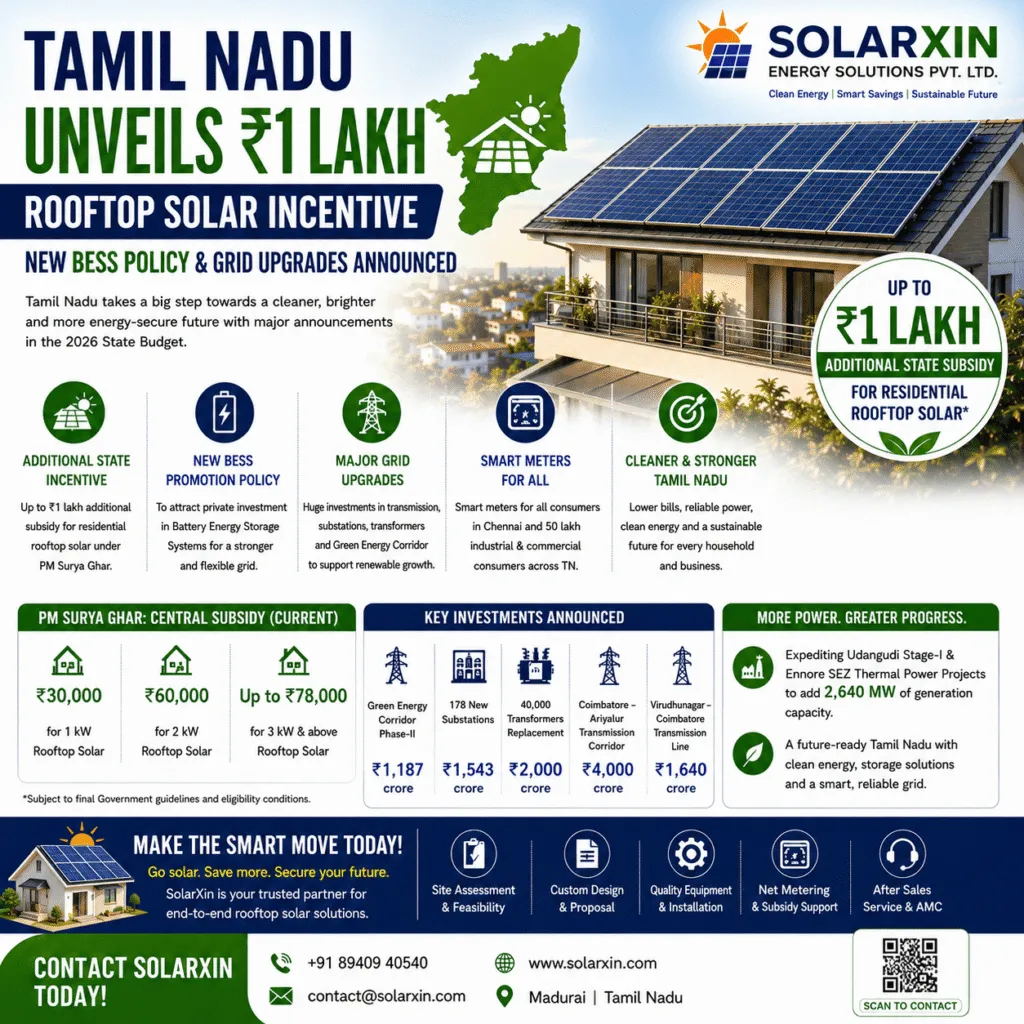
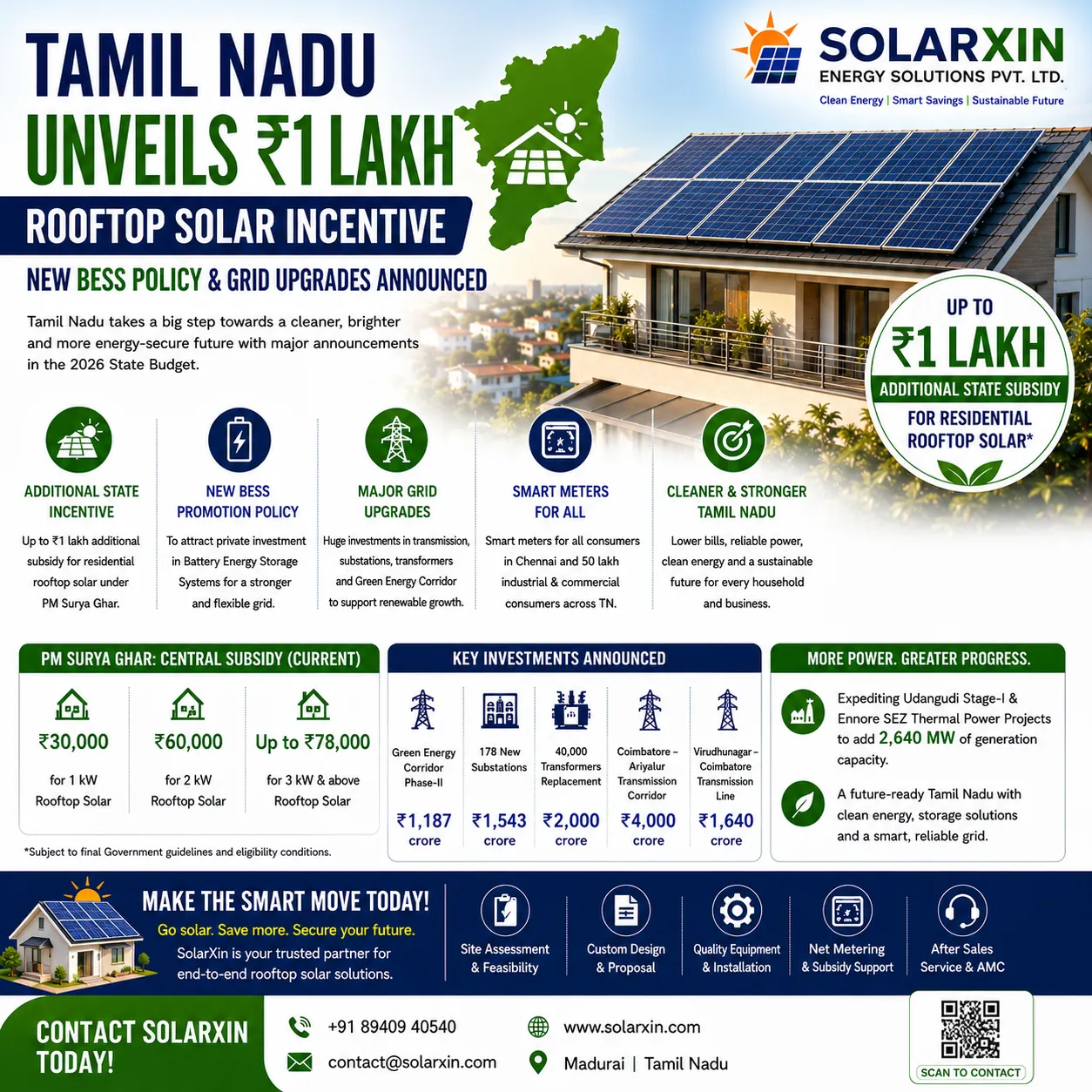
Tamil Nadu is preparing for a major expansion of residential clean energy with new measures aimed at making rooftop solar more attractive to households. The Tamil Nadu Rooftop Solar Subsidy 2026 announcement includes additional state-level financial support of up to ₹1 lakh for residential rooftop solar, alongside plans to strengthen battery energy storage and electricity infrastructure.
The measures could provide a significant boost to homeowners considering rooftop solar, particularly when combined with the existing Central Financial Assistance available under the PM Surya Ghar: Muft Bijli Yojana.
Tamil Nadu is already one of India’s major renewable energy markets. The latest initiatives indicate that the next stage of the state’s energy transition will focus not only on generating more renewable electricity but also on improving storage, transmission and distribution infrastructure.

Up to ₹1 Lakh Additional Support for Rooftop Solar
One of the major announcements is additional state support of up to ₹1 lakh for eligible residential rooftop solar installations.
A budgetary allocation of ₹50 crore has reportedly been earmarked to support the initiative.
The additional assistance is intended to complement the Central Government’s existing PM Surya Ghar rooftop solar programme rather than replace it.
Under the current Central scheme, eligible residential consumers can receive financial assistance based on the capacity of their rooftop solar system.
The applicable Central subsidy can reach ₹78,000 for qualifying systems of 3 kW and above, subject to PM Surya Ghar eligibility requirements and scheme guidelines.
The proposed additional state assistance could therefore make rooftop solar considerably more accessible to eligible Tamil Nadu households.
Consumers should, however, verify the final eligibility criteria, implementation procedure and applicable subsidy amount under the official guidelines before making a purchase decision.
Why This Matters for Tamil Nadu Households
Solar panels generate electricity for decades, but the initial investment can prevent some households from adopting rooftop solar.
Additional financial assistance can reduce this upfront burden.
For eligible homeowners, rooftop solar can provide benefits including:
- Lower dependence on grid electricity
- Reduced electricity expenses over the system lifetime
- Protection against future electricity tariff increases
- Clean electricity generated directly at home
- Better utilisation of available rooftop space
- Long-term contribution towards sustainable energy
The financial benefit for an individual household will depend on electricity consumption, solar capacity, roof conditions, applicable tariff and actual subsidy eligibility.
Tamil Nadu’s Residential Rooftop Solar Market Is Expanding
Tamil Nadu already has a growing residential rooftop solar ecosystem.
The state has reported hundreds of megawatts of rooftop solar capacity across tens of thousands of installations, demonstrating increasing consumer interest in distributed renewable energy.
The new incentive could accelerate this trend by making rooftop solar financially attractive to a wider group of residential consumers.
It could also create additional opportunities for solar EPC companies, installers, equipment manufacturers and service providers throughout Tamil Nadu.
New Battery Energy Storage Policy Planned
Rooftop solar is only one part of Tamil Nadu’s wider clean-energy strategy.
The state has also announced plans for a dedicated Battery Energy Storage Systems (BESS) Promotion Policy.
Battery storage is becoming increasingly important as the amount of renewable electricity connected to the grid grows.
Solar power generation is highest during daylight hours, while household and grid demand can remain high after sunset.
BESS can store surplus electricity and release it later when required.
This can help improve:
- Grid stability
- Renewable energy utilisation
- Peak-demand management
- Electricity reliability
- Integration of additional solar and wind capacity
Tamil Nadu had already identified energy storage as an important part of its renewable-energy strategy, including plans for large-scale battery storage.
Solar Plus Battery Storage: The Next Opportunity
For homeowners, combining rooftop solar with battery storage could eventually provide greater energy independence.
A conventional on-grid rooftop solar system primarily helps consumers reduce grid electricity consumption while solar generation is available.
A solar-plus-storage configuration can additionally store electricity for later use, depending on system configuration.
As battery technologies become more affordable and government policies develop, hybrid solar and residential battery systems could become increasingly important across Tamil Nadu.
Major Grid Infrastructure Investments
Tamil Nadu’s renewable-energy transition also requires stronger electricity infrastructure.
As more solar and wind projects connect to the network, electricity must be efficiently transported from generation locations to consumption centres.
The state is therefore planning substantial investments in substations, transmission corridors, transformers and renewable-energy evacuation infrastructure.
Green Energy Corridor expansion is particularly important because Tamil Nadu has significant renewable generation potential across different regions.
Improving transmission capacity can reduce network constraints and help the state accommodate additional renewable electricity.
Smart Meters and a More Digital Electricity Network
Another important part of the state’s electricity modernisation programme is the expansion of smart metering.
Smart meters can provide utilities with better visibility into electricity consumption and improve billing and network management.
They can also become increasingly valuable as distributed resources such as rooftop solar, electric vehicles and battery storage expand.
Together, smart meters, stronger transmission networks, rooftop solar and BESS can contribute towards a more flexible electricity ecosystem.
What Should Homeowners Do Before Installing Solar?
Government incentives can make solar attractive, but consumers should not select a system based only on the subsidy amount.
The first step should be understanding the household’s actual electricity requirement.
A professional rooftop solar assessment should consider recent electricity consumption, available roof area, shading, roof orientation, sanctioned load and the consumer’s future electricity requirements.
Correct system sizing is essential.
Installing an unnecessarily large system can increase investment, while installing a system that is too small may not deliver the expected electricity savings.
SolarXin Rooftop Solar Solutions in Tamil Nadu
SolarXin Energy Solutions Pvt. Ltd. provides end-to-end rooftop solar solutions for customers in Tamil Nadu.
Our process can include electricity consumption assessment, recommended solar capacity, site survey and feasibility assessment, system design, quotation, installation, commissioning and applicable net-metering or subsidy assistance.
Customers interested in the latest Tamil Nadu rooftop solar incentives can contact SolarXin to understand the appropriate solar capacity for their property and the subsidy options applicable at the time of installation.
Tamil Nadu’s Solar Future Is Getting Stronger
The Tamil Nadu Rooftop Solar Subsidy 2026 could become an important catalyst for residential solar adoption in the state.
Additional financial assistance can reduce the upfront cost for eligible households, while the planned BESS policy could prepare Tamil Nadu for the next generation of renewable-energy infrastructure.
At the same time, investments in transmission, substations, transformers and smart metering demonstrate that the state is looking beyond solar panels alone.
The combination of rooftop solar, energy storage and a modern electricity grid can create a stronger foundation for Tamil Nadu’s clean-energy future.
For homeowners, this represents an opportunity to evaluate rooftop solar not simply as an environmental investment but as a long-term energy solution.
Frequently Asked Questions
How much rooftop solar subsidy is available in Tamil Nadu in 2026?
The announced state initiative provides for additional support of up to ₹1 lakh for eligible residential rooftop solar installations. Consumers should check the final government eligibility and implementation guidelines before applying.
Is this separate from the PM Surya Ghar subsidy?
The state support has been announced as additional assistance alongside the existing Central PM Surya Ghar programme. Final benefit combinations will depend on applicable government rules.
How much Central subsidy is available under PM Surya Ghar?
Under the existing Central scheme, eligible residential consumers can receive ₹30,000 for 1 kW, ₹60,000 for 2 kW and up to ₹78,000 for qualifying systems of 3 kW and above.
Does Tamil Nadu plan to promote battery storage?
Yes. A Battery Energy Storage Systems Promotion Policy has been announced as part of the state’s broader renewable-energy and grid-modernisation strategy.
How can I find the right rooftop solar capacity for my home?
Your recommended capacity should be calculated using electricity consumption, available rooftop space, site conditions and future energy requirements. SolarXin can assess these factors before preparing a rooftop solar proposal.