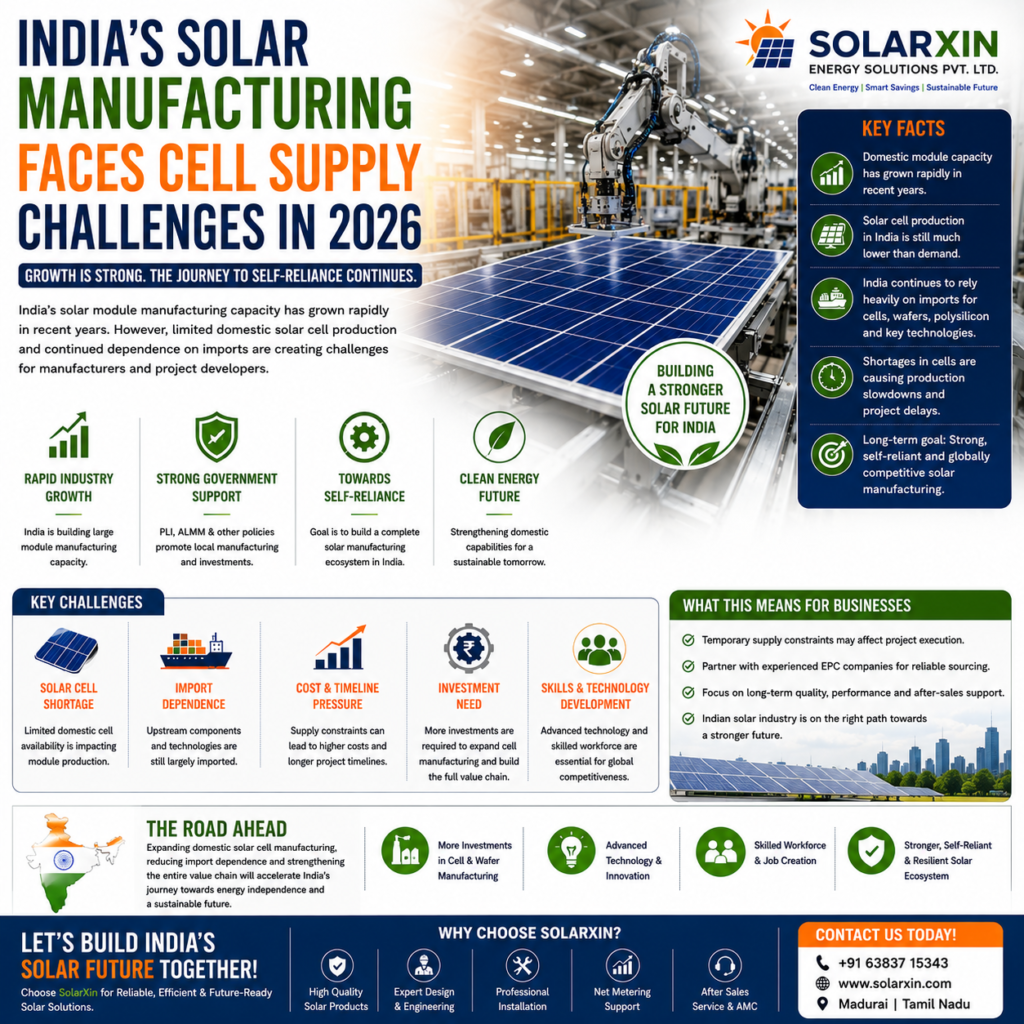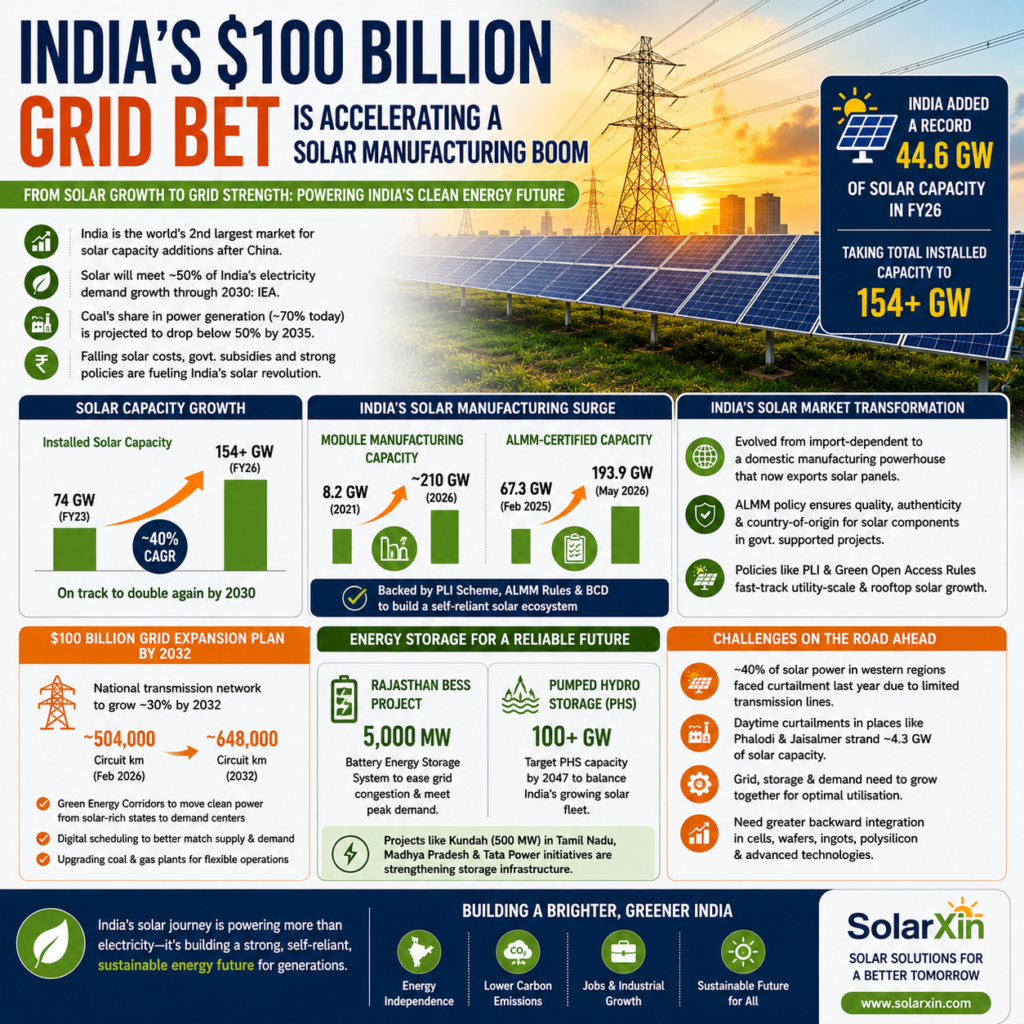


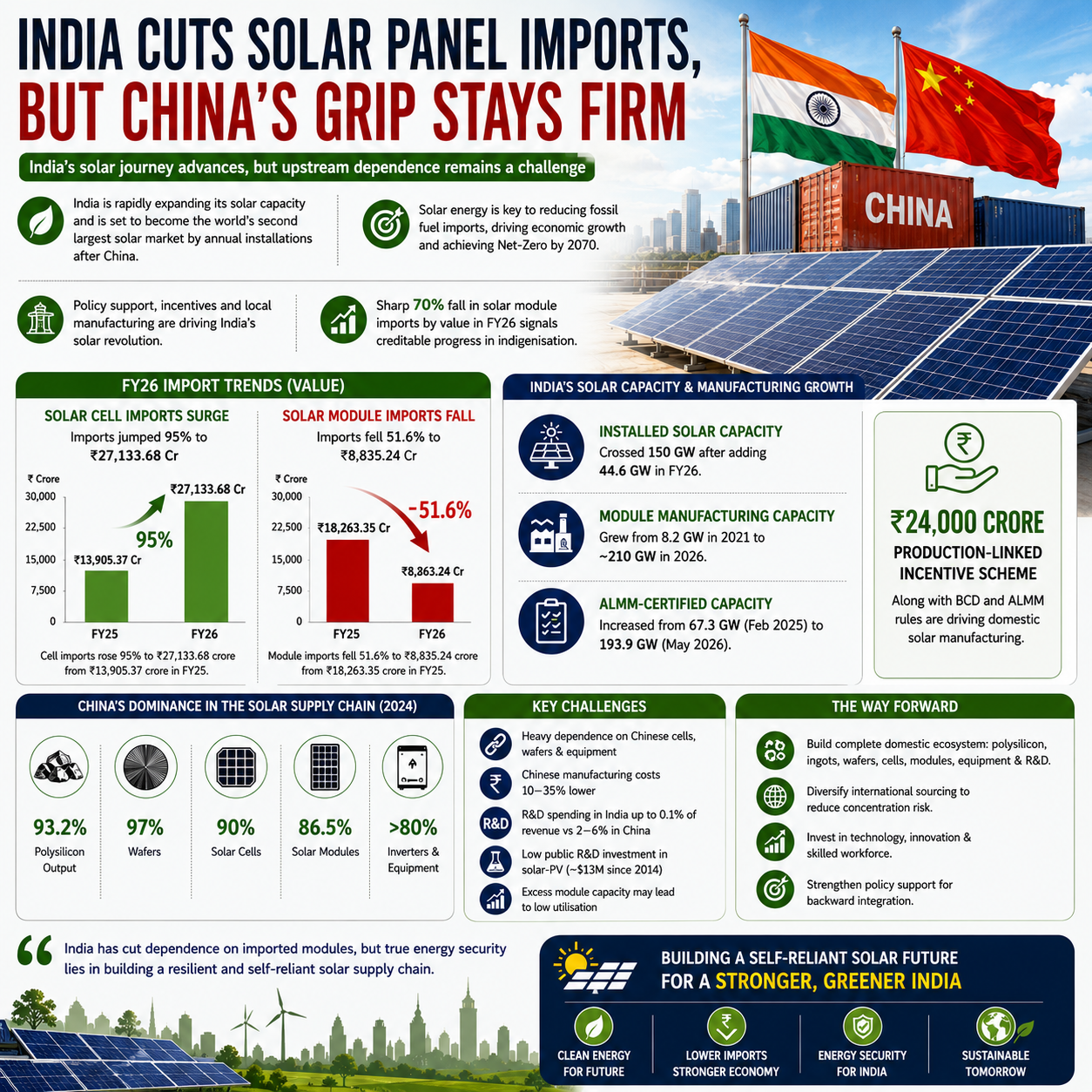


India solar manufacturing has expanded rapidly as the country accelerates its transition towards clean energy. Domestic solar module production capacity has grown significantly, while imports of finished solar panels have declined. However, India continues to depend heavily on imported solar cells, wafers, polysilicon, manufacturing equipment and other upstream components.
This situation highlights both the success and the challenge of India’s solar manufacturing strategy. The country is building a large domestic module manufacturing industry, but achieving complete supply-chain independence will require deeper investment in upstream technologies and research.
Solar Module Imports Decline Sharply
India has made considerable progress in reducing its dependence on imported finished solar modules.
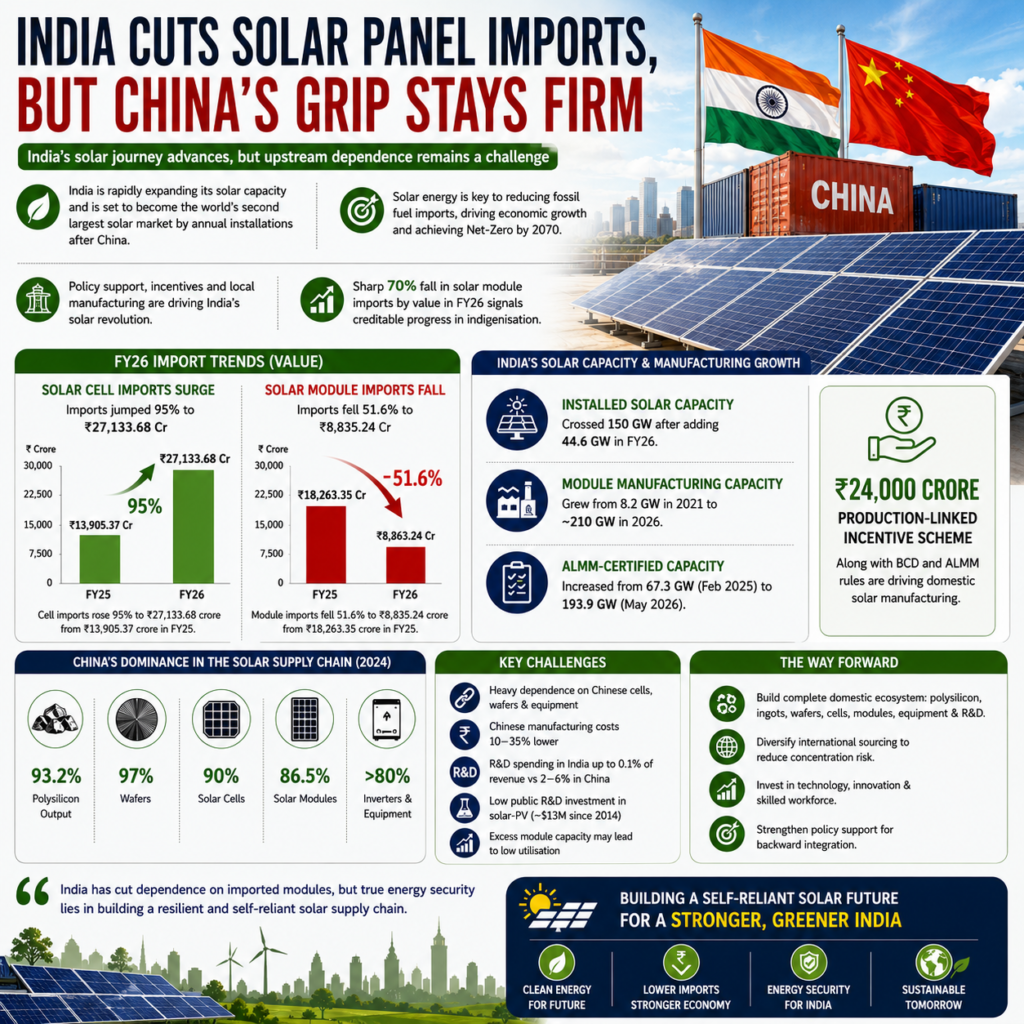
During FY26, the value of solar module imports declined by more than half compared with the previous financial year. However, the overall value of combined solar cell and module imports increased because solar cell imports rose sharply.
The change indicates that India’s dependence has shifted within the solar manufacturing value chain. Instead of importing only finished modules, domestic manufacturers are increasingly assembling panels locally while depending on imported cells and other upstream inputs.
This is an important stage in the development of India solar manufacturing, but it also demonstrates the need for stronger domestic production across the complete solar value chain.
Solar Cell Production Remains a Major Challenge
Solar cells are currently one of the biggest challenges for India’s domestic manufacturing industry.
India’s module manufacturing capacity has expanded much faster than its operational solar cell capacity. As a result, many domestic module manufacturers continue to depend on imported cells to maintain production.
New solar cell manufacturing facilities are being developed, but manufacturing lines require time to stabilise and reach consistent production quality.
Industry investment in new cell production capacity is expected to strengthen domestic supply over the coming years. However, achieving competitive scale and maintaining high technology standards will remain essential.
China Continues to Dominate the Upstream Supply Chain
The global solar manufacturing supply chain remains highly concentrated.
China has a dominant position in several critical areas, including polysilicon processing, ingot production, wafer manufacturing, solar cells, modules and manufacturing equipment.
For India, the biggest concern is the upstream section of this supply chain. Even when solar modules are manufactured domestically, key materials and components used in production may still originate from overseas suppliers.
India has started diversifying solar cell sourcing towards additional international markets. However, complete supply-chain diversification is difficult because several manufacturers in other countries also depend on Chinese wafers, machinery or raw materials.
Government Policies Support Local Manufacturing
India has introduced several measures to encourage domestic solar manufacturing.
The ₹24,000 crore Production Linked Incentive programme for high-efficiency solar PV modules, customs duties and the Approved List of Models and Manufacturers framework have contributed to the expansion of manufacturing capacity.
The ALMM framework is also expanding beyond modules. Domestic solar-cell sourcing requirements have become an important part of the policy environment, while India is also moving towards greater localisation of ingots and wafers.
These policies are intended to encourage backward integration and create a stronger domestic solar manufacturing ecosystem.
Technology and Research Investment Will Be Critical
Manufacturing capacity alone may not be enough to build a globally competitive solar industry.
Solar photovoltaic technology continues to develop rapidly. The industry has already moved from older PERC technology towards newer technologies such as TOPCon and heterojunction cells, while research continues into back-contact and tandem solar technologies.
Indian manufacturers will need to invest consistently in research, advanced manufacturing equipment, material science and workforce development.
Cost competitiveness is another major challenge. Chinese manufacturers benefit from enormous production scale, mature supplier networks, integrated manufacturing and sustained technology investment.
Closing this gap will require collaboration between manufacturers, research institutions, investors and policymakers.
Building a Resilient Solar Supply Chain
India’s renewable energy expansion is creating enormous opportunities for domestic solar manufacturing.
The reduction in finished module imports demonstrates clear progress. At the same time, rising cell imports and continued dependence on wafers and other upstream materials show that the localisation journey is still incomplete.
A resilient solar industry will require domestic capabilities across cells, wafers, ingots, polysilicon, manufacturing equipment and advanced research.
India has already created a large solar market and a rapidly expanding manufacturing base. The next stage will determine whether the country can move from being a major solar installation market to becoming a deeply integrated and globally competitive solar manufacturing hub.
Strengthening domestic technology, encouraging backward integration and diversifying international supply sources will be essential. These steps can help India improve energy security while supporting its renewable energy ambitions and long-term net-zero objective.