

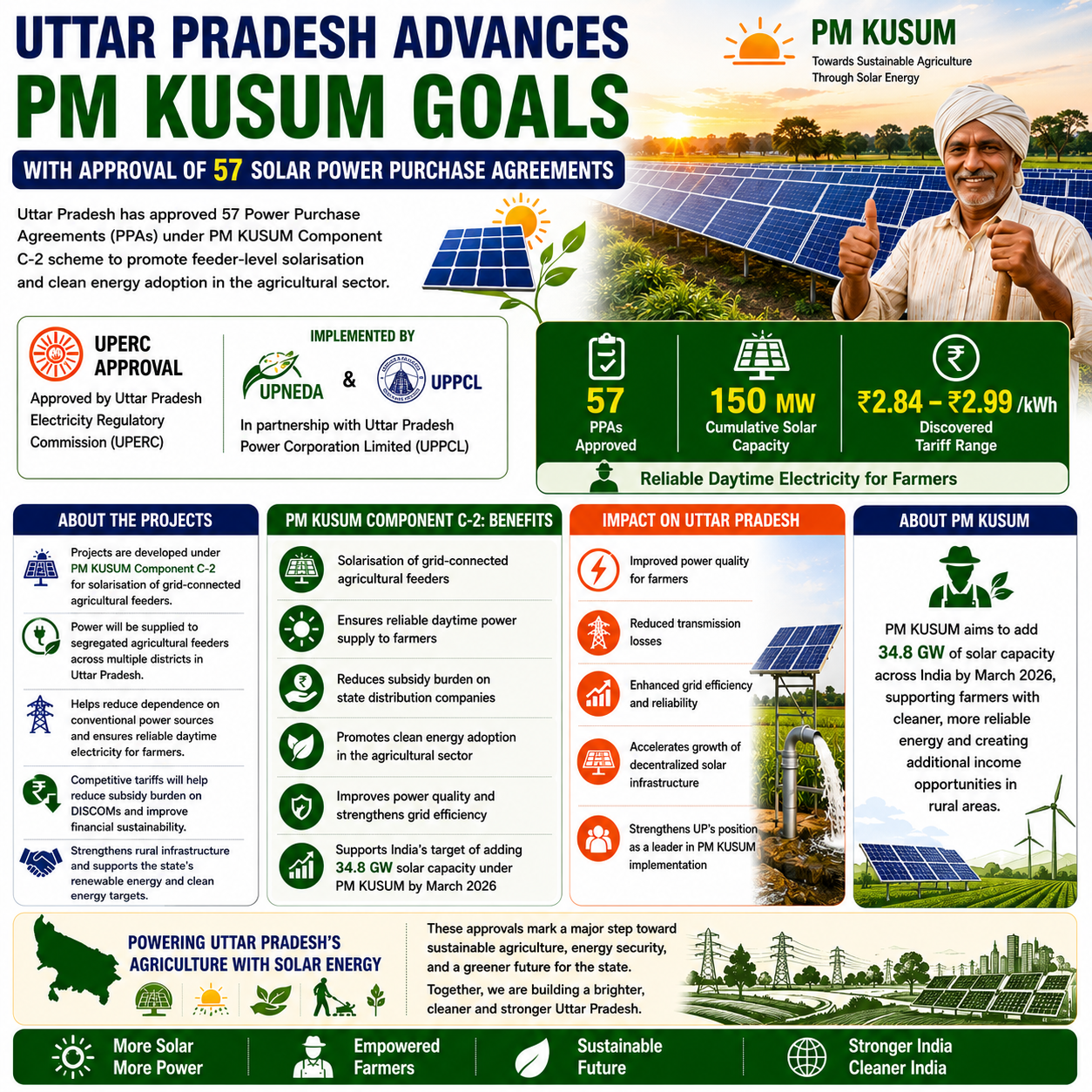


Uttar Pradesh has taken another major step toward agricultural solarisation by approving 57 Power Purchase Agreements (PPAs) under the PM KUSUM Component C-2 programme. The approvals will support feeder-level solar projects aimed at providing reliable daytime electricity to farmers while strengthening the state’s renewable energy infrastructure.
The initiative is being implemented through the Uttar Pradesh New & Renewable Energy Development Agency (UPNEDA) in collaboration with Uttar Pradesh Power Corporation Limited (UPPCL).
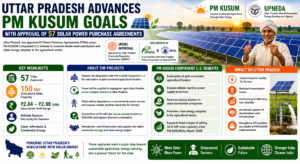
150 MW Solar Capacity Approved
The newly approved PPAs represent a combined solar generation capacity of approximately 150 MW across multiple districts in Uttar Pradesh.
These projects will supply power directly to segregated agricultural feeders, helping reduce dependence on conventional electricity sources while improving power availability for farming activities.
Officials stated that the approved projects are part of a larger feeder solarisation programme being developed under PM KUSUM Component C-2.
Competitive Solar Power Tariffs
One of the key highlights of the approved projects is the competitive tariff structure.
The discovered tariffs generally range between:
- ₹2.84 per kWh
- ₹2.99 per kWh
These rates make solar power one of the most economical energy sources available for agricultural electricity supply in the state.
The lower procurement cost is expected to help distribution companies reduce long-term subsidy burdens while promoting clean energy adoption.
PM KUSUM Supporting Farmers
PM KUSUM Component C-2 focuses on solarising grid-connected agricultural feeders to ensure reliable daytime electricity for farmers.
Key benefits include:
✔ Improved daytime power supply
✔ Reduced dependence on conventional energy sources
✔ Lower subsidy burden on DISCOMs
✔ Enhanced rural energy access
✔ Support for sustainable agriculture
The broader PM KUSUM programme aims to add nearly 34.8 GW of solar capacity across India.
Strengthening Uttar Pradesh’s Renewable Energy Growth
The latest approvals further strengthen Uttar Pradesh’s position as one of the leading states implementing PM KUSUM projects.
Experts believe feeder-level solarisation offers several long-term advantages:
- Reduced transmission losses
- Improved grid efficiency
- Better power quality
- Increased renewable energy penetration
- Enhanced rural infrastructure development
As more projects move toward commissioning, decentralized solar infrastructure is expected to expand significantly across the state.
🇮🇳 Supporting India’s Energy Transition
India continues accelerating renewable energy deployment through solar, wind, battery storage, and hybrid energy projects.
Agricultural feeder solarisation has emerged as an important strategy for improving energy access while supporting the country’s broader clean energy and sustainability goals.
Industry analysts believe PM KUSUM will play a major role in expanding rural renewable energy adoption over the coming years.
The approval of 57 solar PPAs under PM KUSUM Component C-2 marks another important milestone for Uttar Pradesh’s renewable energy sector.
With approximately 150 MW of feeder-level solar capacity set for development, the initiative is expected to improve power supply for farmers, reduce electricity costs, and contribute to India’s long-term clean energy ambitions.